|

This is a story about hope and redemption,
about people from very different worlds coming together to try
to make a better world for all. Joan Duffy was a young, patriotic
Air Force nurse in Vietnam 36 years ago. She returned for the
first time last month at the invitation of the Vietnamese government
to speak at an international conference on Agent Orange. What
she found both horrified and enthralled her.
 “It
was the trip of a lifetime,” Duffy says with passion. “I hadn’t
expected it to be so hard, however. It was a very hard trip for
me emotionally. “It
was the trip of a lifetime,” Duffy says with passion. “I hadn’t
expected it to be so hard, however. It was a very hard trip for
me emotionally.
“Vietnam is so different a place that I felt as if I was
seeing it for the first time. The Vietnam I knew was a nightmare,
engulfed by war, chaos and disorder. The Vietnam I knew is gone;
I’m glad it doesn’t exist anymore.”
The Philadelphia native joined the Air Force six months after
receiving a Bachelor of Science degree in nursing at the University
of Detroit Mercy. She was commissioned a second lieutenant and
assigned to Reese Air Force Base in Lubbock, Texas for a year.
In 1969, she was sent to Vietnam.
“I did not volunteer, but I didn’t object,” Duffy says. “I
believed in the war and that we (the United States) were doing
the right thing” in Southeast Asia. “Plus, I was told that if
I went (to Vietnam), my younger brothers would not be drafted
and sent to Vietnam.” (Neither brother was drafted. Duffy notes
that both received college deferments as the war went on.)
She spent what she calls one hellish year at the Air Force
hospital at Cam Ranh Bay, northeast of Saigon (now Ho Chi Minh
City) on the South China Sea. Duffy recalls, with irony, that
her base — like all American bases in South Vietnam — was sprayed
with Agent Orange twice a day to clear the surrounding area of
foliage that could hide the enemy.

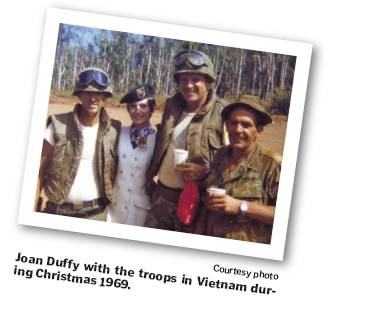
Courtesy photo Joan Duffy spent a year in the Vietnam War as
an Air Force nurse. Her concerns about Agent Orange used in
the war began more than 25 years ago.
Following her one-year tour of duty (November 1969 to November
1970), Duffy returned to the United States and was dismayed by
the reception that returning Vietnam troops received from Americans.
She was spat upon and reviled, although she had never killed anyone
(she was armed, as were all medical personnel in the war zone)
and had helped save both American and Vietnamese lives on the
battlefield.
In the meantime, her views on the war changed, and Duffy
moved to England to protest American involvement in Vietnam. She
married an American and had a daughter, Claire, who now lives
in Australia.
Upon her subsequent return to the United States in 1974,
Duffy embarked on a career in medical communications, principally
writing educational materials for physicians, nurses and patients,
at various pharmaceutical companies in Washington, D.C., and Philadelphia.
She also spent four years as an educationalseminar planner for
major corporations.
Duffy and her daughter moved to Santa Fe in 1998 after vacationing
here and visiting a fellow Vietnam nurse who had relocated to
the City Different. She joined the Santa Fe chapter of Veterans
for Peace just before the invasion of Iraq in 2003.
“I had seen letters to the editor about the organization
in The New Mexican, and I contacted the local president, Ken Mayers,”
Duffy says. She soon joined the war’s protesters every Friday
from noon to 1 p.m. at the intersection of St. Francis Drive and
Cerrillos Road.
Her concerns about the effects of Agent Orange on both Americans
who served in Vietnam and the Vietnamese people began more than
25 years ago. She notes that three of the five nurses at her base,
Duffy included, have suffered various forms of cancer since that
service. What concerned her more was that her daughter began showing
Agent Orange side effects in her immune system when she was 8.
Duffy’s grandson suffered bowel malformation, since repaired,
a condition that various medical studies have related to Agent
Orange exposure.

Kathy De La Torre/The New Mexican Duffy at
home in Santa Fe with four of her five dogs, one of which she
says is a ‘foster dog.’ The former Air Force nurse was among
the five members of Veterans for Peace who attended a March
conference on Agent Orange in Hanoi.
With her background in medicine and pharmaceuticals, Duffy
educated herself on Agent Orange and became an activist on the
subject. She has testified on the subject before Congress and
spoken extensively before concerned groups and the media.
The “trip of a lifetime” to Vietnam and the International
Conference of the Victims of Agent Orange resulted from her activities
and concern. The invitation came from the government of Vietnam
on behalf of the Vietnam Association for Victims of Agent Orange
in cooperation with the Veterans Association of Vietnam and the
Vietnam Union of Friendship Organizations. The host country paid
all her expenses in Vietnam — including visits to Ho Chi Minh
City and Wei, the old imperial city — while she paid for her transportation
to and from Vietnam. Veterans for Peace of Santa Fe will reimburse
75 percent of that expense, Duffy says.
The conference itself received extensive international coverage,
with reports by Reuters and the Associated Press both quoting
Duffy’s speech to the gathering. She was one of 12 speakers and
the first American to speak (after introductions by conference
organizers) on the first day of the two-day conference in Hanoi
March 28-29. Other female speakers included a Parliament member
from New Zealand and a social activist from France. England, Canada,
Australia and South Korea also had representatives at the conference.
Five members of Veterans for Peace represented the United States.

Courtesy photo Duffy and fellow Santa Fean
Ralph Steele study conference materials during the two-day gathering
in Hanoi on Agent Orange. Steele served as an Army helicopter
gunner in Vietnam.
More than 150 participants agreed the second day to a statement
demanding that the United States government and American chemical
companies, specifically Dow Chemical and Monsanto, be held accountable
for health problems in South Vietnam resulting from the use of
Agent Orange there and to “pay compensation equal to their liability.”
In January, a South Korean appeals court ordered Dow Chemical
Co. and Monsanto Co. to pay $65 million in damages to 20,000 of
that nation’s Vietnam War veterans for exposure to defoliants
such as Agent Orange. Legal experts said it might be impossible
for the South Korean veterans to collect damages because of problems
of jurisdiction and the amount of time that has elapsed since
the war.
A U.S. appellate court is expected to rule later this month
on the dismissal of a class-action suit in federal court on behalf
of millions of Vietnamese who charged the United States with war
crimes for using Agent Orange.
The United States has accepted responsibility for several
cancers suffered by American servicemen; however, because there
were many fewer female veterans serving in Vietnam (mostly nurses),
the studies have focused on cancers suffered mostly by men. The
government has not studied the effects of Agent Orange on female
personnel who have developed ovarian and breast cancers.
Duffy says her goals — creating alliances with people from
other countries and holding nations and corporations accountable
for their actions in hopes of preventing future “Agent Orange-type
weapons” from wartime use — were accomplished at the conference.
She also visited four children’s hospitals during her 10-day stay
in Vietnam.
“Agent Orange … is a weapon of mass destruction,” Duffy says.
“It continues to kill and maim in South Vietnam because it has
settled in the ground. Children and grandchildren and beyond continue
to be born with the worst physical and sometimes mental deformities
you can imagine.
“It says something about the Vietnamese people that they
fight to save deformed infants and provide as positive a life
for them as is possible. But they (the Vietnamese) need our help
financially to do this.
“I believe most Americans are pretty fair-minded and would
not go out to deliberately hurt innocent people, especially children,”
Duffy adds. “And, if we find that we did harm innocents, we will
make amends. The biggest thing is to help these children.
“We can’t change what happened 40 years ago, but we can do
the right thing now and help these children of war … and, perhaps,
save those yet to be born,” Duffy says with conviction. “I feel
driven to help the children. I had no idea of the impact they
would have on me; I had no idea how bad it would be for them.
Thirty million Vietnamese are affected by Agent Orange, and it
continues to hurt the children.
“It was tough for me emotionally and physically, but I’m
glad I went,” she says. “And it’s good to be home.”
|
